
There are three topics I would like to discuss in this Market Note:
1) The quarterly price of the Educational Product is going up to $595 starting on September 1, 2025. One of the biggest compliments I’ve received from members is about my consistency. I’ve had a lot of things come up over the past 5 years (sickness, travel, etc.), but I’ve never missed a video. A few have been a little late, but I’ve never missed one. I look forward to continuing to provide strong content and keeping members on the right side of the market, especially as I feel this bull market can continue into 2027 (with normal corrections along the way, of course).
I realize that some members are fairly new to the product, but this is something I was planning on doing in March (which was the 5-year anniversary of the product). For members who were with me back then, I mentioned that I would delay the price hike due to market conditions. Many members appreciated that I did not raise prices during a market correction, especially considering that almost everyone else was doing it. I think I’m the only person to NOT raise prices over the past 5 years. Now, I’m bringing on someone to help me with content behind the scenes. I will definitely need this help if I’m going to continue running the product. In addition, I’m building a new studio to produce new, higher quality seminar videos later this year. Thank you again for your continued dedication to the product. I sincerely appreciate it. If you have any questions about your account, you can email support@joefahmy.com. Also, I am not offering an annual subscription at this time. If that changes, I will let you know.
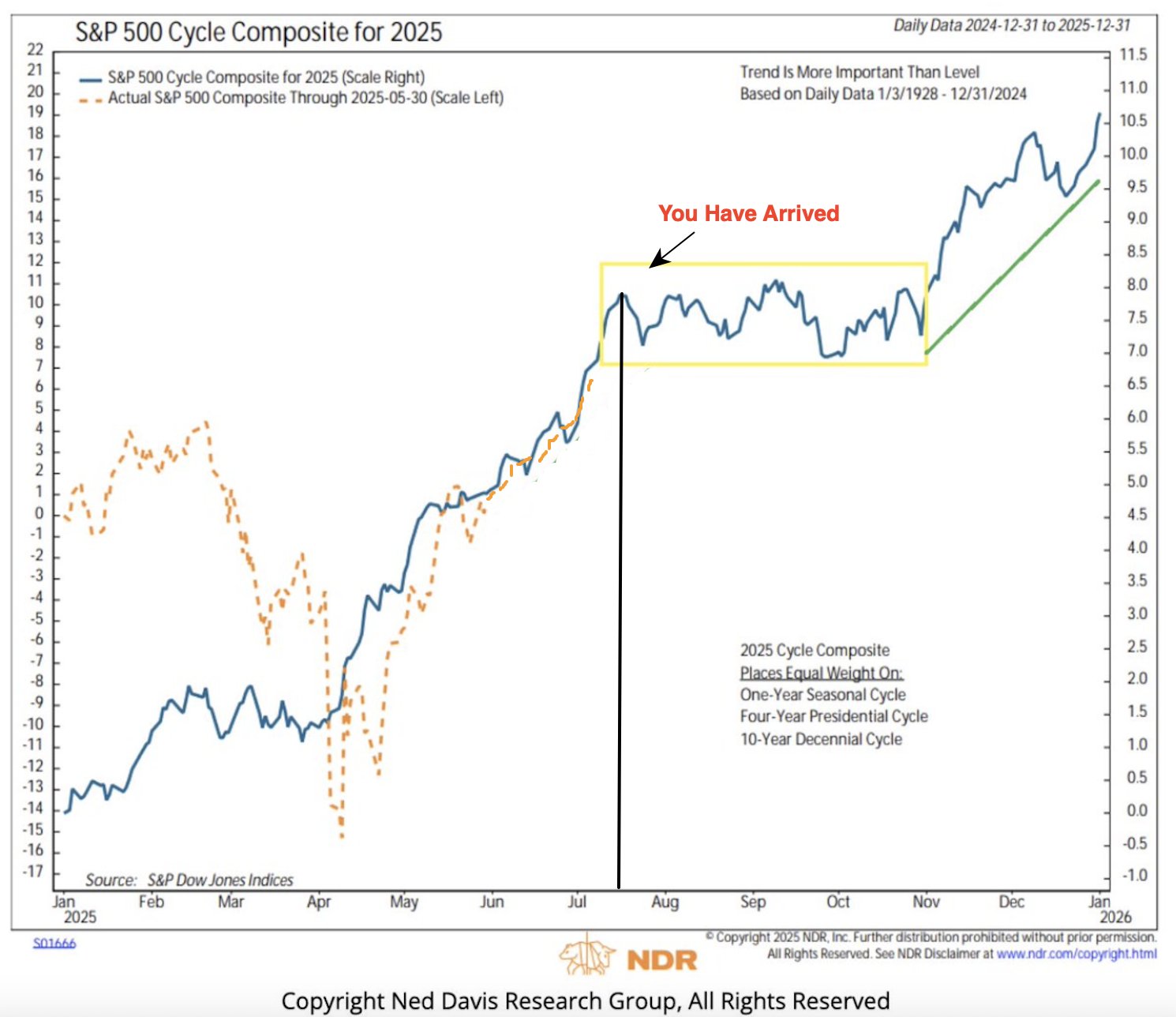
2) Above, you will find a chart from Ned Davis research. It’s a cycle composite chart that places equal weight on seasonality and the Presidential cycle. Basically, it shows that statistically, the market could be in for a choppy period over the next few months. This coincides with a lot of the other work I’ve presented in videos over the past two weeks. Here’s the bottom line: It’s very difficult to think that ANYTHING will ever correct because of recency bias. The market and many of its leading stocks have been incredibly resilient, and the recent unrelentless bid can brainwash us and lull us into complacency. As I’ve mentioned a million times DO WHAT WORKS FOR YOU. I’ve reduced exposure for two main reasons: To lock in gains and to protect capital during a potential seasonally weak period. I don’t foresee a significant pullback, and I’m still bullish longer-term for all the positive reasons I outlined in last Weekend’s Video. Also, I plan to put money back to work when I find better entry points and better risk/reward. Please know your OWN timeframe and stick to your OWN plan.
3) In last week’s MidWeek Video, I mentioned that I would summarize some points about actively managing a stock portfolio.
A) It’s obviously not easy because it involves decision making, patience, discipline, and a lot of mental toughness (which is why I discuss the importance of being mentally tough in the first Seminar Video).
B) My style isn’t for everyone. I NEVER try to, mean to, nor want to impose it on anyone. I’m simply trying to be transparent and present a few strategies that could help people who do like to actively manage their portfolios.
C) One way to outperform is to only trade the power trends (those 2-3 times a year when the market is healthy) and sit out or minimize trading during the unhealthy times. Here’s the problem: IT’S NEARLY IMPOSSIBLE TO EXECUTE because you need the skills to 1) Identify the power trend. 2) Find the leading stocks. 3) Trade them effectively. 4) Cash out/minimize exposure when everything is strong and the market seems resilient. 5) Most importantly, we’re human and we’re market junkies. No one wants to take time off, especially when they are making money. The honest reality is that many of us should, simply for the mental health break.
D) Again, this is NOT EASY and not for everyone. Longer-term, the average person is better off indexing the majority of their money. However, I DON’T WANT TO BE AVERAGE. I want to be like some of the best in the business, which is why I constantly refer to William O’Neil, David Tepper, Paul Tudor Jones, and Stanley Druckenmiller. When Druckenmiller managed money for institutions, he was positive 30 years in a row with an average return of 30% per year (net of fees). Is this possible for most people? Probably not, but it’s something that I think can be done with an incredible amount of discipline (and some luck along the way, too). He mainly did it by identifying his “fat pitch,” aggressively getting involved when he saw great risk/reward, and then reducing his exposure and position size when conditions were no longer as favorable. Again, it is not easy to execute but possible with patience and discipline.